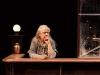
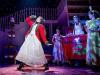
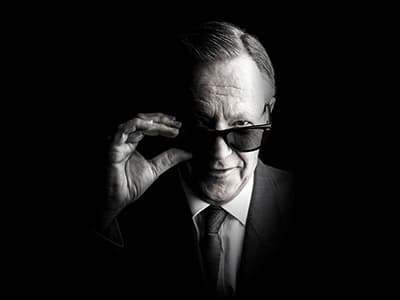
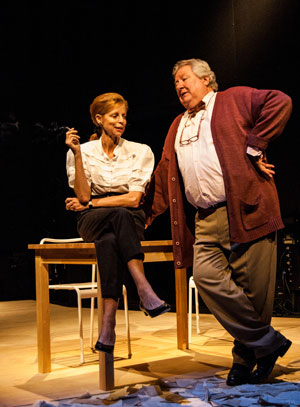
 Left – Heather Mitchell and John Wood. Cover – The History Boys. Photos – Geny Brun
One of the ongoing questions regarding education is the tension between the desire to provide an enriching education in order to create thoughtful, well rounded students and to teach in order to achieve the best possible outcomes in exams.
Set in the 1980s in a boys' grammar school in Sheffield, Alan Bennett’s play, The History Boys is, in part, a coming of age story that ponders the purpose of education, the value of literature and the relationship between truth and history.
The Headmaster, amusingly played by Paul Goddard, is an odious, priggish, fool of a man. He has a crop of exuberant and exceptionally bright A Level graduates and sees them as his opportunity to boost the school’s position on the league table. He wants them to sit the Oxbridge entrance exam but doesn’t trust the eccentric style of their current teacher, Hector, and so employs an ambitious young supply teacher to groom them.
Hector (John Wood) has done a very good job so far teaching English, but the Headmaster has no regard for culture and wants predictable outcomes (as Mrs Lintott observes: “the chief enemy of culture in any school is always the Headmaster”). He also doesn’t trust Hector’s methods. And so begins a battle of teaching styles to win the hearts and minds of the boys.
Hector is now teaching them General Studies in preparation for the entrance exam. He believes knowledge is important in its own right and it doesn’t need to have a tangible use. Hector’s classes are a conspiracy between him and the boys. He locks the classroom door against ”the spectre of modernity”. He makes them learn poems by heart, not because it might be useful now, but so that the boys will have the language and insight to deal with whatever happens in their lives – and be armed with the antidote for the inevitable grief to come.
Unlike the straightforward, facts-based Mrs Lintott, the history teacher who taught the boys for the A Levels, the new teacher Irwin has arrived from Cambridge armed with a cynical bag of tricks designed to dazzle the Oxbridge examiners.
As much as Mrs Lintott sticks to the facts, the young Irwin, by contrast, is using knowledge to gain the greatest effect. He likes to play fast and loose with the facts and subvert them. Apparently based on the historian Niall Ferguson, Irwin wants to stir the historical pot to make his name. “A question has a front door and a back door,” he tells the boys, “go in the back or better still, the side….be perverse, defend Stalin.” His formula is to contradict historical truisms in order to attract the attention of the examiners who are probably bored rigid after reading a hundred essays with the same point of view.
The boys are simultaneously in his thrall and see through him. The more the boys learn to use Irwin’s intellectual tricks however, the more they come to challenge Hector’s values and we see a shift in the boys’ allegiances from Hector to Irvin; from romanticism to cynicism; from the world of the possible to the pragmatic world. It is like a loss of intellectual innocence, moving from the pure to the pragmatic.
While the audience is inclined to empathise with Hector, Bennett is not idealising him. Hector is a successful teacher but he has marginalised himself from the real world and seeks refuge in the consolation of poetry. There is a great melancholy about Hector, who thinks of his life as missed opportunities. “What made me piss my life away in this God-forsaken place? There’s nothing of me left.”
The boys, in fact, learn from all three teachers. Hector feeds their soul, Mrs Lintott provides them with a solid historical grounding, and Irwin “adds the sprig of parsley” and makes them canny.
Hector’s weakness is his penchant for feeling up boys on the back of his motorcycle. This is something they have good naturedly resigned themselves to as an act of charity and they have devised a roster so they all share the responsibility. Bennett has been criticised for a glib rendering of schoolyard sexual abuse. In interviews Bennett contextualises it in terms of documented research on the sexualisation of the act of teaching and ameliorates the seriousness of the act by explaining that the boys are all 18 and know how to handle themselves. Textually, however, Bennett doesn’t let Hector off lightly at all. He is considered a sad old fool by the boys and, in respect to his fumblings, fate well and truly catches up with him.
Integrity is a central idea in the play. Irwin’s view that “truth is no more at issue in an examination than thirst at a wine tasting” is criticised by Mrs Lintott who accuses him of sensationalising history and turning it into journalism. Irwin’s tricks are exposed as shallow showmanship when he tries to justify the holocaust by saying it was part of the framework of traditional, expedient, German foreign policy. This is contrasted with the boys’ view of Hector that “he led you to expect the best”.
That this Peach Theatre Company production is as enjoyable as it is comes down to the strength and wit of Alan Bennett’s terrific script. The cast is strong and Jesse Peach’s direction is mostly sound, if a little workmanlike. Because of this, the production lacks the sparkle that a play of this calibre deserves.
James Mackay’s Irwin is well performed for the most part, for example, but the scenes between him and Dakin are awkward, coy, sentimental, and far too guileless. The last third of the second act also seems to lose momentum. Finding out about the accident lacked the power that it should have had. Even the funeral scene seemed flat, except for a beautiful rendition of Bye Bye Blackbird by the boys.
Similarly, John Wood – an actor with so much natural charm – seemed tentative about embracing the flamboyant, intellectual eccentricity of Hector. It is hard to follow in the shoes of Richard Griffiths, who created the role of Hector for the original National Theatre Company production and the film and won a string of awards in London and New York. I wondered if the production needed more time in the rehearsal room for Wood to make Hector his own.
Heather Mitchell and Paul Goddard, however, delivered fully realised characters as the sharp Mrs Lintott and the slimy Headmaster respectively. The boys were all strong, in particular Matthew Backer as Jewish late developer Posner, Lindsay Farris as the cock-sure Dakin and Aaron Tsindos as Scripps.
Emily O’Hara’s set was simple and functional, if a little under-designed and not particularly attractive. Consisting of a timber-covered rostrum on one side of the stage, a lower section on the other and screwed up paper on the floor at the front, it allowed the cast to set up tables and chairs for the different scenes effectively but didn’t add anything to the production.
No doubt the production will develop in performance and, in the meantime, there are plenty of ideas and wit in the script and plenty of acting talent to make up for it.
Peach Theatre Company presents
THE HISTORY BOYS
by Alan Bennett
Venue: Playhouse, Sydney Opera House
Dates: Feb 8 - Mar 2, 2013
Times: Tues/Wed 6.30pm Thurs - Sat 7.30pm Matinees: Sat 1pm / Sunday 4pm
Tickets: $35 - $65 + $20 Tuesday - February 12
Bookings: 9250 7777 | sydneyoperahouse.com
Visit: www.peachtheatrecompany.com.au